

I intended to use the title, ‘A post-stoic psychotherapeutic model for dealing with negative emotions’ for this article. But, in the world of clickbait, we need emphatic titles.
Be that as it may, I am not here to talk about titles, but about a model I’ve been working on for the past five years or so. Ever since I first came across the Stoics in Sharon Lebell’s diminutive but profound book, ‘The Art of Living’, I have been consumed by the philosophy of the Stoics. No this isn’t dry philosophy practiced in university departments, but living philosophy that aims to answer the question, “How can I live well?”
The Stoics invented mental exercises, just like Indian Yogi’s invented (or perhaps discovered) physical exercises to keep the body healthy. These mental exercises were simple, yet as I said profound. One of the first steps in becoming a Stoic is to understand the difference between the externals and internals. Differentiating between what I can truly control and what I can’t control is crucial to live a peaceful life, and a life “well lived”.
But what is truly in my control?
The Stoics quickly dismiss nearly everything – how other people treat you, other’s words, unforeseen situations, the weather, the government and so on. One cannot control how people behave with you. One cannot control if we are let go from our jobs. One cannot control if our partner will leave us. One cannot control if our investments go bust. One cannot control if we or our loved one falls grievously ill. These things might happen – we have to admit – whatever their probability of occurrence. In fact it happens to many people all the time. The Stoics say that expecting these things to go according to your plan is a recipe for disaster. It is a perfect brew for a turbid inner life.
The only thing in our control, say the Stoics, is our judgements about things. This needs explanation. Judgements means how we interpret that which happens to us. It is the inner narrative – the mental commentary about bad or good things that happen to us. For instance: let’s assume we visit a car service center to get our car serviced and they overcharge us for doing nothing. Naturally this upsets us. But almost instantaneously the mind begins to develop a narrative – a story that revolves around a central actor – “me”. It might say, “How dare he does this to me”, “There ought to be a law against people overcharging the consumer”, “Let me write a review on Google” and so on. These stories are called judgements in the language of the Stoics.
But aren’t we justified in our judgements? After all the car service center did cheat us. True – as pure fact. But at that instant we are using the veracity of the fact to justify and perpetuate an emotion. We are looking for a reason to be and stay angry. And as we all know any action that comes out of hurt, upset or anger does more damage that any short-term pleasure that may come from it (for instance the joy that comes from picking up the phone and yelling at the service person).
Thus, if we want to be peaceful, we need to be able to replace that judgement with a healthier one. One that supports our inner serenity. How can we do that?
This is where a model can help. The picture below shows two pathways in a similar event that nearly all of us are familiar with – someone insulting us.
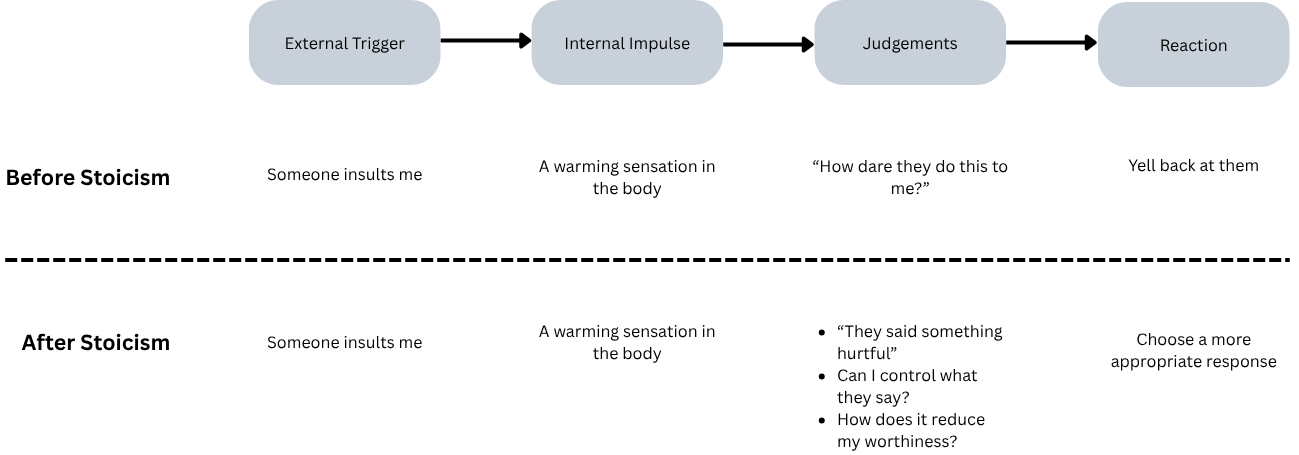
A pre-stoicism response would involve getting upset for hours, possibly days. In contrast, a stoic response would be a calmer one that would not elevate the conflict, but rather seek to diffuse it.
Does this mean that the Stoics are losers? No. It simply means that the Stoic knows which battles to pick. She sees if she can indeed change the person. If the other person is amenable to advice and admonitions (how many people really are?) then the Stoic would ask the other to change their views. But as we all know, insulting insinuators do not listen. They accuse and provoke. The Stoic on the other hand values inner serenity over teaching the other a lesson. So they let go.
Now most of us would say – it is impossible to choose our response. The logical brain shuts down during times of heightened emotion. This is true. And this is where I think the Stoic thought can be extended with ideas from other traditions – especially eastern ones of mindfulness.

This is where, I think, the eastern approach of watching one’s emotions can help regain a semblance of control. Becoming aware of one’s thoughts, helps separate oneself from the thought. This tells us that we are safe as the observer and the emotion or the thought is not so imperative/urgent as it may seem to be. The very act of observation can help ground us. Once we are fairly calm – an exercise that shares roots in Stoicism but also in eastern and western devotional traditions can help. Setting a will (Father Thomas Keating’s contemplative Christian prayer and the Hindu traditions of Sankalpa) is immensely useful. The will isn’t a wish. It is our prefered sense of direction. It is akin to entering a destination in our phone’s navigation app – we aren’t there yet – but it’s where we would like to go.
The will is an exertion of our innermost selves – it is us shaping ourselves – it is us gently nudging ourselves in a direction we would like to see ourselves go. When we ask, “Who would I like to be?” nearly nobody would say, “I wish to be an angry, frustrated and short-tempered person”. We would say, “I wish to be a calm person who can handle this situation with equanimity”. Setting this will, or more accurately becoming aware of who we want to be now at this moment, is like weighing anchor on a stormy sea. It is the foundation of developing our characters.
More often than not, when we ask this question, there can be a terrific conflict within our emotional systems. We know, rationally we want to be calm and dignified, but our emotional system might say, “I don’t care what happens”. This is why the previous step of mindful attention is critical. Only ask “Who I want to be” once the emotions have adequately subsided.

What do you think of this model? This model appears as a collection of essays in my latest book, ‘Teaching Myself to be Free : Ancient philosophy for inner peace and outer effectiveness‘. Please support me by downloading it on Amazon Kindle, reading it and sending in your comments. I am curious to learn if this philosophy is indeed as helpful to all of you as it has been to me.


