
Introduction
Over the last few months, I have spent a great deal of time in silence and deep reflection. In particular, I have been thinking about the impact that Artificial Intelligence (AI) will have on us, our work, and society in general. To be absolutely certain, we are at the dawn of a new age. For a while, I resisted fully recognizing this reality, but as I’ve delved deeply into AI’s capabilities, particularly with ChatGPT, I am struck by its enormous potential. It fascinates me and, at the same time, fills me with a sense of unease.
The Potential of AI
As a researcher, one of my core responsibilities is producing knowledge in the form of written content. Currently, ChatGPT can often generate written material that is significantly better and faster than what I can produce, despite my many years of experience. Its language, tone, and professionalism are impressive. However, it is still prone to inaccuracies. It sometimes prioritizes eloquence over true comprehension. But we must remember that these are early days—comparable to the first wave of processors, like the Celeron or Pentium, compared to today’s dual-core or quad-core technology. AI is improving—and at a remarkable pace.
This is exciting, given the possibilities it opens up. For instance, AI removes the barrier of needing to be a skilled writer to contribute to the knowledge field. Even if someone lacks the ability to write professionally or organize their thoughts effectively, ChatGPT can help them do so. The only requirement is the creative impulse and a desire to share. This development has the potential to democratize knowledge, a domain historically dominated by consultants and professors (usually with a high opinion of themselves). Academic publishing, with its often unnecessarily complex writing style and exclusive journals, may be one of the first casualties. Today, large language models (LLMs) trained on academic papers can easily rephrase rather unpolished content to give it the tone of a tenured professor. This truly democratizes knowledge production.
Furthermore, AI could open up entirely new areas of human endeavor. Just as Google Maps facilitated app-based delivery and taxi services, AI will likely create new opportunities by empowering individuals without traditional skills to communicate like professional knowledge workers. However, it is not yet clear what specific services AI will foster—but I am certain we are witnessing a turning point for knowledge industries.
The Risks of AI
Of course, there are risks. One is the inevitable flood of content—much of it useless—that will become part of our lives. We already see this with YouTube and Instagram. As content creation becomes easy and inexpensive, separating the wheat from the chaff becomes increasingly difficult. The proliferation of ranking algorithms exacerbates this issue, as we rely on popularity as a proxy for quality. True value risks being overshadowed by widespread appeal. This has a herd mentality effect—people follow what is popular, often for fear of missing out. Tourism provides a poignant analogy: many flock to crowded spots like Venice or the U.S. National Parks, not necessarily driven by a deep desire to connect with culture or nature, but simply because these places are deemed “must-see.” The same dynamic could unfold in the knowledge industry, with AI-generated content leading to a superficial pursuit of popularity rather than meaningful inquiry.
Commercialization and Influence
Another risk is the commercialization of AI. The development of these tools required massive investment, and those costs will eventually need to be recovered. Although many of these tools are currently free, it is likely we will eventually pay—in one form or another. The greatest danger may come from advertising. Imagine a scenario in which AI models are subtly tuned to promote certain products, without disclosing the sponsorship. Because AI can mirror our analytical thinking and creative processes, it could target ads with unprecedented precision. For instance, if I prompt ChatGPT with “What are the pros and cons of shifting to an electric car?”, it might slip in a phrase like, “Modern electric cars, such as the latest Kia model, offer a range of over 400 miles.” This kind of influence, subtle and unnoticed, risks undermining intellectual autonomy.
The risks extend beyond advertising. What if AI companies allow corporations, political entities, or governments to buy influence over responses? The content delivered to users could vary based on location or political context, as we already see with certain countries controlling their citizens’ access to information. The internet was a relatively open space until commercial and political interests gradually usurped it in the 2010s. We could expect a similar trend to unfold in the AI space. The difference, though, being that the AI tools and the way they are trained are not fully open to the public, as the internet was (and some would argue still is).
Job Displacement and Education
AI will inevitably replace and displace jobs. Just as personal computers rendered typists and stenographers obsolete, AI will affect both knowledge workers and workers involved in repetitive tasks. In the service sector—such as call centers and receptionist roles—AI could easily outperform humans. In manufacturing, it could replace certain skilled jobs that automation has not yet eliminated. Even education may be affected. Today, many pursue education for degrees rather than for true learning, with the goal of securing prestigious jobs. AI could disrupt this dynamic, providing alternative pathways to acquire skills, particularly in fields like programming and creative writing, and thus democratize learning, if not formal education.
The opportunities and risks presented by AI lead us to consider the broader context of technological advancements over time. By understanding past revolutions, we may gain insights into where this current revolution could take us.
Technological Revolutions in Perspective
To put this revolution into perspective, we can look back into the annals of history, especially moments of unprecedented change. I see four major technological shifts over the past 200 years:
1. The Industrial Revolution (mid-1700s to early 20th century):Replaced human labor with machines, improved productivity, and brought advancements in steel production, electricity, and mass manufacturing.
2. The Information Technology Revolution (1950s to today): Heralded the digital age with the invention of the transistor, introduced digital devices and computers, replacing analog machines, automating data processing, and reducing reliance on human memory.
3. The Intelligence Revolution (today): A shift from simple automation to enhancing and replacing cognitive tasks, potentially transforming all aspects of decision-making and problem-solving.
The Future: Dystopia or Insight?
The question is: what’s next? A dystopian future suggests that humans might become a passive mass of consumers, losing the ability to discern what is genuinely good or valuable. It could foster a false sense of empowerment through trivial choices—like the perfect coffee order or banal brand preferences—while masking the reality that true freedom, as some wise people say, is not about exercising endless consumer choice but about being free from an endless treadmill of desires.
There is also a more hopeful vision. The Industrial Revolution replaced the need for physical labor, which eventually led to a resurgence of intentional physical activity—from Swedish gymnastics to modern yoga. Today, many of us no longer perform manual labor out of necessity but exercise by choice. However, this consciousness shift is not universal, and obesity has become a widespread problem. This isn’t technology’s fault per se, but rather a reflection of the lack of human wisdom. Similarly, the AI revolution could prompt a shift toward deeper understanding, or as I call it, “insight.”
The Insight Revolution: Bridging the Gap Between Technology and Humanity
My hope is that by offshoring our analytical capabilities to machines, we might have the opportunity to use our intellect not in the pursuit of wealth through our careers, rather in the true quest for knowledge and for deep human connection. I would like to think of this as an “Insight Revolution” that fosters true wisdom, beginning with self-knowledge, deeper awareness of our surroundings, and connection to what truly matters. The initial signs are present: younger generations are yearning for meaning and purpose in their work, and many of us feel a longing for something deeper that we often cannot articulate. This next revolution could emphasize empathy, understanding, and the value of simply being—if, of course, commercial and political interests allow it.
It also calls upon each one of us to live more consciously and act agentically instead of being passive participants in the drama of life, which today is sadly characterized by mindless consumption and endless work. This implies that each one of us must live more consciously, constantly making value judgments on what empowers us and what disempowers us. The onus also falls on society to make decisions on how we want to reinvest the gains in productivity. Do we want people to work harder and on more projects? The email is a classic example: as professional communication got cheaper and faster, we ended up receiving endless emails.When computers replaced manual work, we were expected to work faster and on more projects. To whom would these gains in productivity accrue? Would it buy us time for my own philosophical ruminations and time with family, or to the bottom-line of businesses?
Final Thoughts
The dystopian outcome is one where AI further enslaves us into cycles of endless consumption and endless work that is targeted at enabling even greater consumption. Today’s humans are already spending less of their time on “what truly matters”. At the same time, when I hear people celebrate how “human-like” AI is becoming, I don’t necessarily feel elated. Instead, I am saddened that we are losing our sense of what it means to be truly human. The beauty of a child’s laughter, a pet’s enthusiasm after a long day, or Beethoven’s “Emperor” Concerto—no machine can ever experience this, even if it simulates it convincingly. As philosopher Bernardo Kastrup aptly puts it, imagining AI consciousness is like simulating kidney function on a computer—it may be accurate, but it will never actually urinate. We risk mistaking the map for the territory.
An insight revolution would require us to reconnect with our humanity and move beyond a purely utilitarian view of people. As the Trappist monk Thomas Merton once said, “We are so obsessed with doing that we have no time and no imagination left for being. As a result, men are valued not for what they are but for what they do or what they have—for their usefulness.” My hope is that the next age will encourage us to value simply being human and to experience the joy of life for its own sake, rather than for any external or material gain.
As I wrote this article, I found myself lost in the process of creative expression. This is why I work in the realm of producing knowledge—because I lose myself in it. The process of transforming nebulous thoughts into concrete sentences is an absolute joy. It is my flow state. While I did use ChatGPT to refine this article, that was done with a clear, distinct goal in mind—to improve the quality of the text. However, when I wrote the initial draft, my only goal was to express myself freely and authentically. This distinction, I believe, illustrates the limits of AI. It can enhance, facilitate, and contribute to the creative process, but it can never replicate the infinite joy of human experience in self-expression.
Yes, AI can improve and facilitate creativity, but the pure act of experiencing something—the joy of deeply engaging in an activity—will always remain uniquely in the human domain. This makes me envision a shift in our cultural values, one where we prioritize the expression of human potential over mere productivity, where we transition from valuing output and efficiency to valuing the richness of human experience. This, I believe, is something that no machine will ever truly be able to replicate.
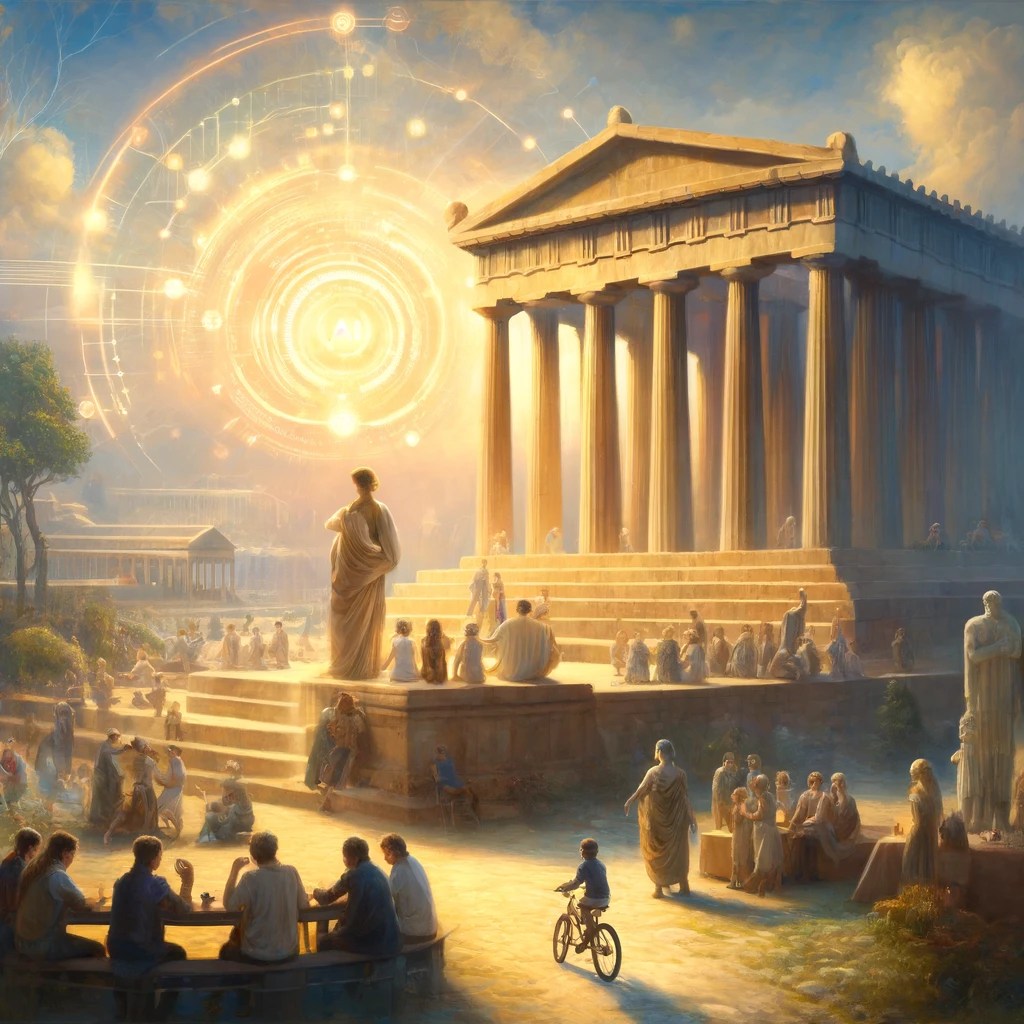

 Journey of a thousand words